Nature
Lake Hallstatt (Hallstätter See): Ferry, Boat Tours, Swimming and the Lakeside Path
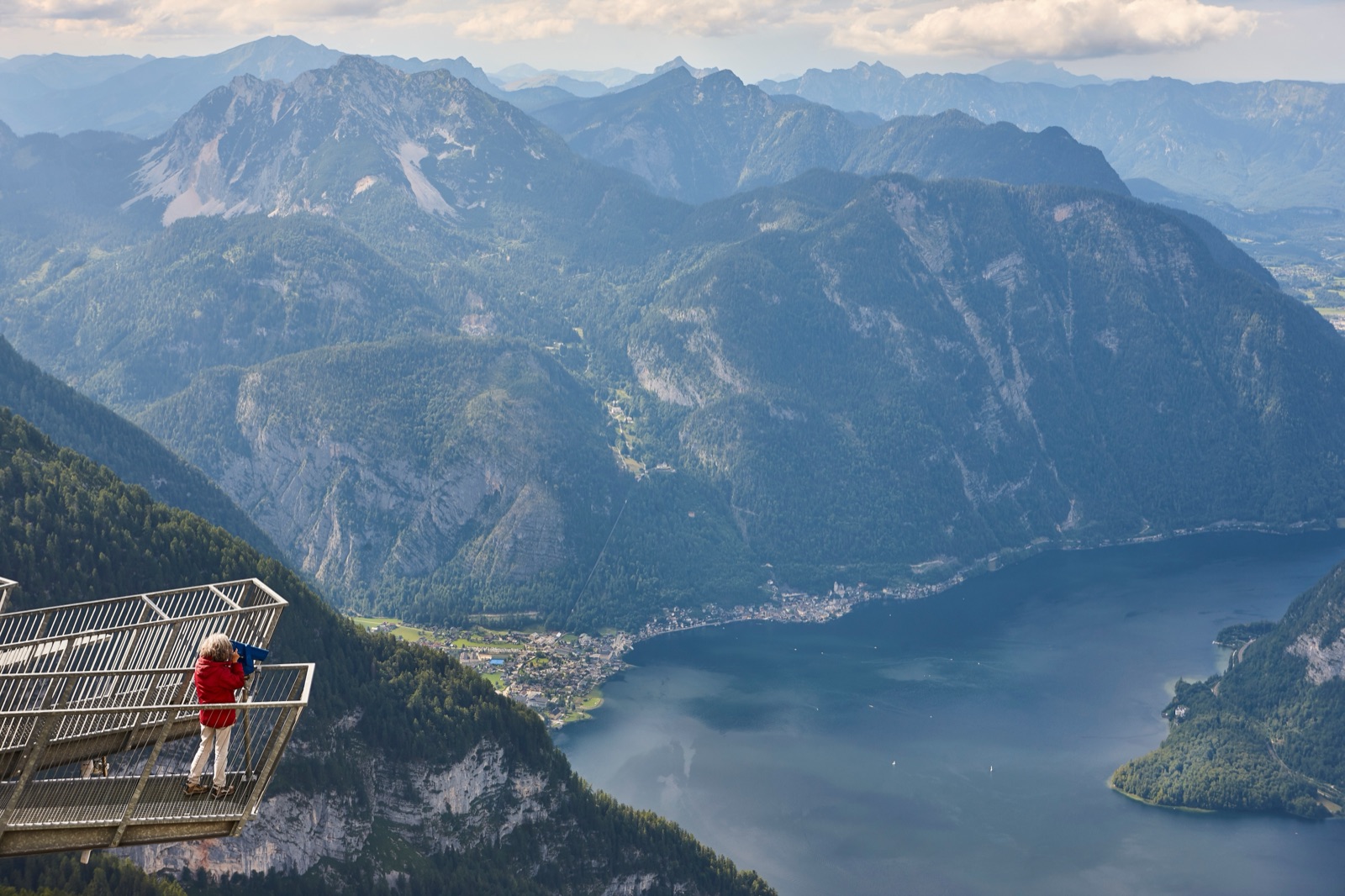
Lake Hallstatt, the Hallstätter See, is a narrow mountain lake about eight kilometres long and 125 metres deep, at 508 m above sea level. Hallstatt clings to its western shore, Obertraun sits at its southern end and Bad Goisern at its northern end. The Traun flows in and drains it again. The railway runs along the opposite shore, which is why Hallstatt’s station is across the water and a ferry has linked the two since 1881.
For visitors the lake is more than a backdrop. It is the way in by train, the best viewpoint of the village and a place to swim in high summer. It also played a working part in the story of Hallstatt’s salt. This article covers the lake’s figures and where its water comes from, the ferry, the round trips, the traditional Zille boats and boat hire, the swimming places, the paths along the shore, the lake procession at Corpus Christi, fishing and diving, and the lake in winter.
The short answer
- Size: about eight kilometres long and two wide, up to 125 m deep. The exact figures differ by source, as the next section shows.
- Ferry: from Hallstatt station to Hallstatt Markt every day of the year, €4 one way, cash only.
- Boat tours: the southern round trip via Obertraun, about 50 minutes, from May to September, €18 for adults.
- Boat hire: electric boats, rowing boats, pedal boats and paddleboards at the landing stage in Hallstatt, in fine weather from April to mid-October.
- Swimming: free lidos at Obertraun and at Untersee in Bad Goisern, with water of up to 24 degrees in summer.
- Walking: the east-shore trail from Bad Goisern past Hallstatt station to Obertraun.
Lake Hallstatt in figures
Every source agrees that the lake is about 125 m deep. They disagree on almost everything else, so treat the length and width as approximate.
| Source | Length | Width | Area | Depth |
|---|---|---|---|---|
| Regional tourist board | 7.75 km | 2.3 km | 8.55 km² | 125 m |
| The boat operator | 8.6 km | 2.2 km | not given | 125 m |
| The village’s own site | 8.2 km | 2.1 km | 8.58 km² | 125.2 m |
| Upper Austria’s water authority | not given | not given | 8.5 km² | up to 125 m |
The boat operator adds that the lake is 22 km round and lies at 508 m. The village’s site calls it the fifth-largest lake in the Salzkammergut. It lies in the Upper Austrian Salzkammergut, in the district of Gmunden. In the regional tourist board’s words, the three World Heritage villages of Bad Goisern, Hallstatt and Obertraun and the mountain Sarstein border the lake, which belongs to the Austrian Federal Forests.
Where the water comes from and where it goes
The lake is fed by four rivers and streams: the Traun, the Gosaubach, the Waldbach and the Zlambach. It drains through the Traun. The regional tourist board gives the lake’s water retention time, the average time water stays in it, as 0.49 years.
That steady through-flow shapes the lake’s character. Upper Austria’s water authority says that because of the strong flow of the Traun, the lake does not warm up much even in summer. After storms the water is sometimes clouded with fine mineral sediment; otherwise, the authority says, its low nutrient content keeps it clear.
The landscape is the work of ice. The water authority describes the lake as fjord-like in the south, between the steep slopes of the Dachstein massif, and flatter towards the north. The village’s site says this fjord-like setting was shaped by ice-age glaciers, and that the lake took on its present form about 10,000 years ago. The last great ice age began about 80,000 years ago, and the glaciers started to withdraw from the Salzkammergut about 18,000 years ago.
The ferry from the station
Hallstatt station is on the eastern shore, beside the east-shore cycle and walking path, so rail travellers finish their journey by boat. The ferry Stefanie runs between the station and Hallstatt Markt every day of the year, and a ferry is ready for every train arrival and departure. The crossing takes about 15 minutes.
- Fares: €4 one way and €8 return. The operator’s fare table shows the return ticket with priority boarding.
- Payment: cash only. The operator takes no cards on any of its boats.
- Bikes: €4 on the ferry, which makes it useful for cyclists on the east-shore path.
- Children and dogs: children under 4 travel free if they do not take a seat of their own, one per adult. Dogs must be muzzled and on a lead.
- Access: the Stefanie carries up to 150 passengers and has wheelchair-accessible boarding.
- Delays: departure times can change when trains run late, because the boat waits for the train.
The route has run since 1881, and the regional tourist board says it is the only boat service on an Austrian lake that keeps running through the winter. Getting to the station and the trains is covered in the guide to getting to Hallstatt.
Round trips on the lake
Boat travel on the lake goes back to 1862, according to the tourist board. Today’s scheduled boats are run by Hallstättersee Schifffahrt, owned by the Hemetsberger family since autumn 1967, with a fleet of four ships. Besides the ferry, there are two round trips:
| Trip | Season | Route | Adult fare |
|---|---|---|---|
| Southern round trip | May to September | Hallstatt Markt, Hallstatt Lahn, Obertraun and back by the suspension bridge stop, about 50 minutes | €18 |
| Northern round trip | 18 July to 16 August | Hallstatt to Untersee and Steeg and back | €25 |
Southern round trips leave Hallstatt Markt at 11:00, 13:00, 14:00 and 15:00, with an extra 16:00 sailing in July and August only. The 11:00 calls at Hallstatt Lahn at 11:10 and Obertraun at 11:25. Children aged 4 to 13 pay €12 on the southern trip, and a bike costs €9.
There are also one-way and all-day options:
- One way to Obertraun: €12, on the 11:00, 13:00 and 14:00 sailings.
- One way to Steeg or Untersee: €15 for adults and €10 for children, on the northern route.
- Day ticket: €35, for as many trips as you like on all the boats that day.
Tickets are valid only on the day you buy them, and sailings can be cancelled in bad weather. The round-trip boat MS Hallstatt carries 190 passengers, is heated, serves drinks and has wheelchair-accessible boarding. The MS Goisern, which carries 150, has no wheelchair access, so ask which boat is sailing if that matters. The southern trip is the one to take for the classic view: the tourist board points out that only from the lake do you see the village with the mountains around it.
The Zille: a ride in a salt boat
The second operator on the lake, NAVIA, uses a historic boat, the Zille. In the Salzkammergut it is also called a Fuhre or a Plätte, and in the past these were the workboats that carried salt on Lake Hallstatt and the Traun.
NAVIA’s trips leave from the Seecafé in Obertraun or from the pier on Seestraße in Hallstatt:
- A scheduled service between Obertraun, Hallstatt and Bad Goisern (Obersee), by reservation.
- Sightseeing loops round Hallstatt, from 30 minutes to 2 hours.
- Fares: Obertraun to Hallstatt €12.00 for adults and €9.00 for children and teens under 17, or €20.00 and €13.00 return. The short Hallstatt tour costs €16.00.
- Extras: children under 6 travel free, subject to space, and bikes, pushchairs and dogs cost €1.00 each.
Like the main boat company, NAVIA takes cash, and it gives discounts with the SommerCard guest card. Check its timetable before you plan around it, since its trips run to a schedule and some need booking.
Hiring your own boat
Bootsverleih Schwarzmayr, at the landing stage in Hallstatt, hires out boats for you to steer yourself:
| Boat | 30 minutes | 60 minutes |
|---|---|---|
| Electric boat | €28 | €38 |
| Swan pedal boat | €15 | €20 |
| Stand-up paddleboard | €15 | €20 |
It also hires rowing boats. It opens daily from 10:00 to 17:00 from April to mid-October 2026, but only in fine weather, takes no reservations and accepts cash only. Between Hallstatt and Bad Goisern, the bathing place at Gosaumühle, by the car park and bus stop, has a kiosk that hires out canoes, kayaks and paddleboards.
Learn the storm lights first. Warning lights at the north and south ends of the lake are visible from anywhere on the water. A slowly turning orange light means a storm is coming and you should stay near the shore. A fast-turning one means leave the lake at once.
Swimming: where, and how cold
All the bathing areas and lidos around Lake Hallstatt are free to use. The two main ones are:
- Obertraun lido, which the tourist board calls one of the most beautiful and well-kept bathing places on the lake. Entry is free and parking costs €2.00 an hour or €18.00 a day. It has a large jetty and a pool lift for wheelchair users, and it is 100 m from the Obertraun Bahnhof/Feriendorf bus stop.
- Untersee lido in Bad Goisern, at the northern end of the lake.
There are smaller bathing places in Hallstatt itself, in Obertraun and in Bad Goisern, including Gosaumühle. The sites tested under the EU bathing-water rules are the Untersee lido, Freibad Hallstatt-Kesselgraben, the Seelände in Hallstatt and the Obertraun lido. Results are published by AGES, Austria’s food and health safety agency, from mid-June each season.
Expect fresh water. The regional tourist board gives the lake’s temperature as 1 degree in winter and up to 24 degrees in summer, and its Obertraun lido page says up to 23 degrees. The Traun’s through-flow keeps it from warming much, so the water is at its best only in high summer. Month-by-month air temperatures and rainfall are in the article on Hallstatt’s weather.
Walking and cycling along the shore
The road along the western shore is busy, so the lake’s best path is on the other side. The east-shore trail runs from Bad Goisern past Hallstatt station to Obertraun, and a cycle path follows the same shore. The village’s site describes the walk in stages:
- From Obersee to Hallstatt station: about 45 minutes to 1 hour from the Seeraunzn inn near Obersee station. The station, at 520 m, is the highest point of the walk, and the ferry crosses from there to the village.
- Over the suspension bridge: the trail crosses a suspension bridge over the Wehrgraben, at the lake’s deepest point, 125.2 m.
- On to Obertraun: about 1 hour further from Hallstatt station.
The railway runs parallel to the trail, with stops at Steeg-Gosau, Obersee, Hallstatt and Obertraun, so you can walk one way and take the train back. Cycling all the way round the lake is possible in theory, but beyond the east-shore path you are on the road, which the tourist board does not recommend because of the traffic, poor visibility and its narrowness.
A small-group bike ride of about 3.5 hours follows the quieter eastern shore from Steeg-Gosau station, through Obertraun and into Hallstatt village.
The lake in the salt story
The lake was a working route long before it was a view. The Zillen carried salt on the lake and down the Traun. In the sixteenth century, when the salt mine was surveyed completely for the first time, the plans were laid out full size on a field in Obertraun or, in cold winters, on the frozen lake.
The brine pipeline is the lake’s other link to salt. Salzwelten, the mine’s operator, dates the inauguration of the pipeline between Hallstatt and Ebensee to 1607. It was over 30 kilometres long and needed 13,000 hollowed tree trunks. Brine still flows through the modernised pipeline to the saltworks at Ebensee, which makes it, in Salzwelten’s words, the oldest industrial pipeline in the world. The village’s site gives the same date and length. Other sources differ: the regional tourist board says construction began in 1595 and the first brine reached Ebensee in 1607, Bad Ischl’s town chronicle dates its construction to 1613, and the tourist board and the Natural History Museum Vienna give its length as 40 km.
The pipeline’s route is now a walking trail, which Salzwelten gives as about 32 km, from Steeg at the north end of the lake through Bad Goisern and Bad Ischl to Ebensee; the village’s site, which describes it in stages, gives 15 km from Steeg to Bad Ischl and about 19 km on to Ebensee. Parts of it are closed to cyclists and unsuitable for pushchairs.
The lake shore was settled long before the pipeline. The Romans built a large settlement by the lake in what is now the Lahn district. Divers can still see underwater trees dating from 600 to 400 BC. The prehistoric story is told in the article on the Hallstatt culture.
Corpus Christi on the lake
Once a year the lake becomes the stage for a procession. At Corpus Christi the villagers decorate their traditional boats, the whole village dresses up, and the procession moves onto the water. The Jesuits introduced it. Because the little salt village had so little space on land, the procession was moved onto the lake in boats and salt ships, partly so that it could look up at the Salzberg, where the people of Hallstatt had worked for thousands of years.
The next procession is on 27 May 2027:
- 09:00: mass in the Catholic parish church.
- 10:15: a blessing on the market square, then the procession on the lake.
- About 12:00: back on land, with the final blessing on the market square.
You can watch from the shore or follow the procession on a round-trip boat, which leaves Hallstatt Markt at 10:15. The ticket desks open at 08:45, and since places are limited, the organisers advise arriving early.
Fishing and diving
Fishing is allowed on Lake Hallstatt, and the season runs from May to October. The lake holds whitefish, char, pike and trout among others. Licences are issued at the Monika Wallner petrol station in Hallstatt, the Struger fishing company in Bad Goisern and the Sams fishing shop in Bad Ischl, and permits can also be bought online through hejfish. The daily limit is 3 salmonids, of which no more than 2 may be whitefish.
Diving is allowed too, and the Hallstatt diving station at Lahn is the centre for it. Under the water are the trees dating from 600 to 400 BC and the wreck of the Kronprinz Rudolf. There is also an underwater altar with a Madonna and Child, where divers can even be married. The Dachstein Salzkammergut diving club advises on dive sites, and diving needs proper training and local guidance.
The lake in winter
In winter the lake goes quiet. The southern round trips run only until the autumn, the boat hire closes in mid-October, and the lake cools to about 1 degree. The ferry keeps running, though, every day, to meet the trains, so even in January the crossing from the station is a short trip on the lake.
Plan for the weather, since boat trips can be cancelled when it turns bad. What else is open in the cold months, from the salt mine to the Christmas market, is in the article on Hallstatt in winter.
Planning a day on the lake
- Arriving by train: take the ferry from the station, then the southern round trip later for the view from the water.
- With a few hours to spare: walk part of the east-shore trail from Hallstatt station and take the train back.
- With children: the Obertraun lido, with the jetty and the pool lift, or a pedal boat from the landing stage.
- With a day ticket: use the boats as transport between Hallstatt, Lahn and Obertraun, and combine the lake with the Dachstein cable car, covered in the guide to Hallstatt and the Dachstein.
- Always: carry cash for the boats, and save the lake for a clear day if the view is the point.
The rest of the village, from the market square to the waterfalls of the Echern valley, is in the guide to things to do in Hallstatt.
Frequently asked questions
How much is the ferry from Hallstatt station to the village?
€4 one way and €8 return, cash only. The ferry runs every day of the year to meet the trains, and the crossing takes about 15 minutes.
How long is the boat tour on Lake Hallstatt?
The southern round trip via Hallstatt Lahn and Obertraun takes about 50 minutes and runs from May to September. It costs €18 for adults and €12 for children aged 4 to 13.
Can you swim in Lake Hallstatt?
Yes. All the bathing places are free, with lidos at Obertraun and at Untersee in Bad Goisern. The water reaches up to 24 degrees in summer, but the Traun’s through-flow keeps it cool.
How deep is Lake Hallstatt?
About 125 m at its deepest. The village’s site gives 125.2 m, at the point where the east-shore trail crosses a suspension bridge.
Can you rent a boat in Hallstatt?
Yes. Bootsverleih Schwarzmayr at the landing stage hires out electric boats from €28 for 30 minutes, and pedal boats and paddleboards from €15. It opens in fine weather from April to mid-October and takes cash only.
Is there a path around Lake Hallstatt?
Not all the way round on foot. The east-shore trail runs from Bad Goisern past Hallstatt station to Obertraun, and the railway runs alongside it for the return.