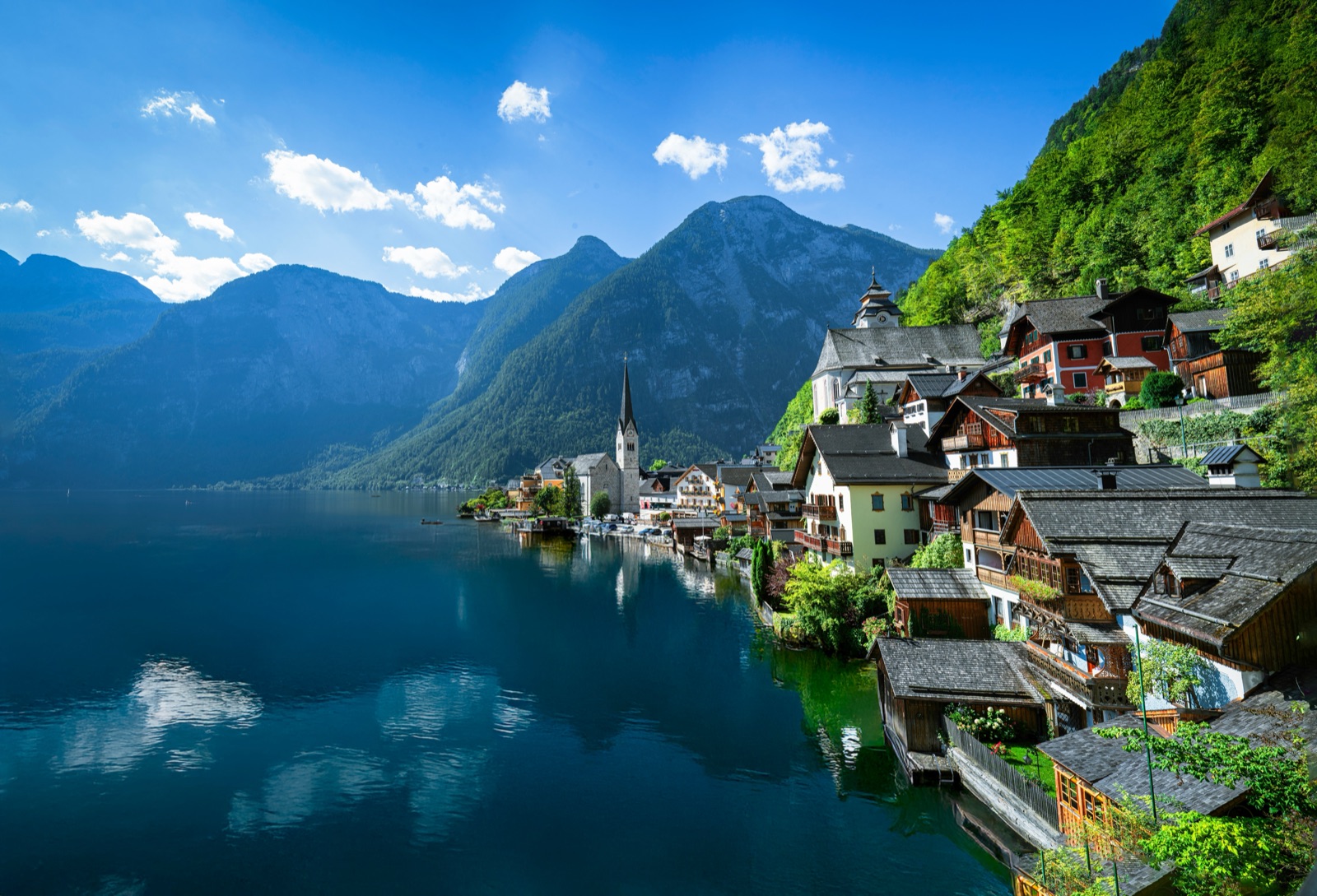
Things to Do in Hallstatt: The Village, the Lake, the Salt Mine and the Mountains
What there is to do in Hallstatt falls into four groups. The village itself: the market square, two churches, the Bone House and the World Heritage Museum. The mountain above it: the salt mine and the Skywalk, reached by funicular. The lake: the ferry, the round-trip boats and boats for hire. And the valleys and mountains around it: the Echern valley and its waterfall, the Dachstein caves and 5fingers above Obertraun, at the southern end of the lake, and Lake Gosau. A day covers the village and one big sight; two days let you do both the salt mine and the Dachstein without rushing.
Each comes with how, when, what it costs and how long to allow; where a sight has its own page on this site, you get the essentials and a link. Prices and hours change between seasons, so check before you go.
The short list
| What | Time to allow | Cost | When |
|---|---|---|---|
| Market square and a walk through the village | About an hour | Free | Any time; early or late for fewer people |
| Catholic church and Bone House | Under an hour | Bone House €2, cash | Daily from April to October; Wednesday to Sunday from November to March |
| World Heritage Museum | An hour or two | €12 adult | Daily, all year |
| Salt mine, funicular and Skywalk | At least 3 hours | €49 adult; Skywalk only €29 | Open into January 2027 |
| Dachstein caves and 5fingers | Half a day to a full day | €66.20 adult for everything | 1 May to 1 November 2026 |
| Southern round trip by boat | About 50 minutes | €18 adult, cash | May to September |
| Echern valley and Waldbachstrub | About three hours there and back | Free | All year; may close in snow and ice |
| Lake Gosau | Half a day | Free to walk | Circular trail May to October |
The market square and a walk through the village
The market square is the centre of Hallstatt and the place to start. Its layout dates back to the 14th century, and in the middle stands the Holy Trinity Column, donated by a Hallstatt salt-making couple in the middle of the 18th century. The column had stood for 6 years when the fire of 20 September 1750 swept the square. It started in the Keferbäck house, now the site of Café Derbl. The village’s site says four people died and 35 houses in the centre burnt; the Natural History Museum Vienna records that all the state buildings and nine salt producers’ houses were lost. Hallstatt was rebuilt afterwards in late Baroque style.
- Around the square: souvenir shops, cafés, restaurants and a bar, with a waterfall near the salt mine splashing down behind.
- On the square: concerts by the saltworks band in summer, a large children’s party at the end of July, a station of the Corpus Christi procession, and the Christmas market on 8 December.
- A self-guided walk: the tourist board’s walking tour through the village is 2.7 km, takes about 49 minutes and is rated very easy. From the Hallstatt Nord bus stop it passes the photo spot and the square, follows the promenade to Hallstatt Lahn and returns by the Covered Stairs to the Catholic church and the Bone House.
- Getting there: the centre is about 10 to 15 minutes on foot from the buses and car parks at Hallstatt Lahn.
The postcard view, and the village’s rules for visitors
The classic postcard view, often called the Classic Village Viewpoint, is a short walk from the market square, on the walking tour’s route from the northern end of the village. From there you look across the lake to the Protestant church, the old houses packed against the rock and the boat landing stage, with the mountains behind. It is also the busiest spot in Hallstatt; early morning and evening are the times to have it to yourself.
The village’s own question-and-answer page reminds visitors that Hallstatt is not an open-air museum but a place of residence with about 750 inhabitants, so there are no opening hours and no entrance fee. In return it asks for a few things:
- Speak quietly, and stay off private property. Do not walk into gardens or houses.
- Leave the drone at home. The village says drones are not a welcome sight, because they repeatedly invade the privacy of the inhabitants, and suggests a photo from the Skywalk instead.
- Use the bins. Rubbish belongs in the bin, not on the street.
- Watch your belongings. The village warns that thieves target wallets, phones and other valuables in the crowds.
Two practical notes: there are two public toilets in the village, and luggage can be stored at the valley station of the salt mine funicular.
The Catholic church and the Bone House
The Catholic parish church stands on the slope above the market square, reached by an alley and the Covered Stairs. A small Romanesque church probably stood here from around 1181, and its 12th-century tower survives; the present late Gothic church, built out over the steep rock, was completed by 1505. Its treasure is the late Gothic winged altar by the master craftsman Leonhard Astl. The church also has an odd recent history: in 1987 an Italian couple tore four Gothic paintings from the small altar of the Virgin Mary, and all of them were seized in a raid in Italy in 2017 and returned.
Beside it, in St Michael’s Chapel, is the Bone House. It holds 1,200 skulls, 610 of them painted with names, dates and wreaths of flowers, a custom that began in 1720. The cemetery cannot be expanded and cremation was not allowed in the past, so graves were reopened 10 to 15 years after a burial and the bones moved to the ossuary.
- Entry: €2 for adults and €0.50 for children aged 6 to 15, cash only.
- Hours: daily from 11:30 to 15:30 in April, from 10:00 to 18:00 from May to September 2026 and 10:00 to 17:00 in October. From November it is closed on Mondays and Tuesdays: the village’s site gives Wednesday to Sunday, 11:30 to 15:30, until the end of March, while the tourist board’s listing gives 11:30 to 14:30, so check before the climb.
Behind the cemetery, the Hallstätter Höhenweg climbs a few steps to the Marienruhe lookout and runs over the roofs of the village to the funicular. The story behind the painted skulls is in our article on the Hallstatt culture.
The Protestant church
The Protestant church, whose spire is the focus of the postcard view, stands a few steps from the market square by the landing stage. Luther’s teaching took hold among the region’s miners, and the authorities pushed back: in 1734 soldiers deported 300 Protestants from Hallstatt, Ischl and Goisern, not counting women and children, to Transylvania. Emperor Joseph II’s Edict of Toleration of 1781 allowed Protestants to practise their faith within limits, and both the tourist board and the village’s site date their first house of prayer to 30 October 1785. The present Neo-Gothic church was completed in October 1863, after five years of building.
- Visiting: a plaque at the portal tells the church’s history in German and English.
- Concerts: the church hosts concerts regularly, especially in summer.
- The ferry: the boat to the station leaves from the centre near the church.
The World Heritage Museum
The museum at Seestraße 56 shows what the high valley above the village has given up: original finds from the prehistoric burial ground that gave the Hallstatt culture its name, with displays on religion, everyday life and tourism. It uses holographic displays and three-dimensional presentations, and the tourist board pitches it as an experience for the whole family.
- Entry: €12 for adults, €8 for children, €20 for a family.
- Hours: daily, from 10:00 to 18:00 between May and September, 10:00 to 16:00 in April and October, and 11:00 to 16:00 from November to March.
The salt mine, funicular and Skywalk
The salt mine above the village reopened on 29 August 2026 with a new funicular, which climbs to the high valley in 2.6 minutes. At the top, the Skywalk is a 12-metre platform over the rooftops, and a walk of about 15 minutes leads to the mine.
- Tickets: €49 for an adult with the guided tour and the funicular, or €29 for the funicular and the Skywalk alone.
- Time: at least 3 hours; the tour itself takes about 90 minutes.
- Hours: the last tour starts at 4.30 p.m. until 1 November 2026, and at 3.00 p.m. from 2 November 2026 to 6 January 2027.
- Walking up: the footpath to the high valley is closed for building work, so the funicular is the way up.
The salt mine and Skywalk guide has the tour, the tickets and the hours in full.
The Dachstein caves and 5fingers
At Obertraun, at the southern end of the lake, 10 minutes from Hallstatt Lahn on bus 543, the Dachstein Krippenstein cable car climbs to the Giant Ice Cave, at -2°C, and the Mammoth Cave, and on to the 5fingers platform over a drop of more than 400 metres.
- Tickets for summer 2026: €50.20 for both caves, €46.70 for the cable car and the platforms, or €66.20 for everything in one day.
- Season: the cable car to the Krippenstein, 5fingers and the Giant Ice Cave run daily from 1 May until 1 November 2026, and the Mammoth Cave from 9 May. In winter the mountain is a ski area, from 19 December 2026.
Save 5fingers for a clear day and the caves for a grey one. The Dachstein guide has the timetable and a plan for the day.
On the lake: boats, boat hire and swimming
The boats are run by Hallstättersee Schifffahrt and take cash only.
- The ferry to the station: every day of the year, €4 one way or €8 return.
- The southern round trip: about 50 minutes via Hallstatt Lahn and Obertraun and back, from May to September, €18 for an adult. Sailings leave Hallstatt Markt at 11:00, 13:00, 14:00 and 15:00, with an extra 16:00 in July and August.
- A boat of your own: Bootsverleih Schwarzmayr, at the landing stage, hires out electric boats and rowing boats daily from 10:00 to 17:00 in fine weather, from April to mid-October 2026. Learn the storm warning lights before you set off.
- Swimming: the bathing areas and lidos around the lake are free, with lidos at Obertraun and Bad Goisern. The water reaches up to 24 degrees in summer.
Our article on Lake Hallstatt covers the boats, the storm lights, swimming and the traditional Zille boats.
The Echern valley and the Waldbachstrub waterfall
The Echern valley opens behind the village. The tourist board’s Echern theme trail starts at car park P2, next to the funicular valley station, and follows the Waldbach stream past old houses and information boards about the painters and writers who came here, among them Adalbert Stifter and Ferdinand Georg Waldmüller. A turn-off leads to the glacier garden, a relic of the last ice age, with potholes ground out under a glacier that retreated around 12,000 years ago.
The goal is the Waldbachstrub, where three streams, the Waldbach, Klauskogelbach and Lauterbach, meet and fall. The sources describe it differently: the village’s own site speaks of a 90 m gorge over three levels, the tourist board of waterfalls plunging over 50 metres.
- How long: the village gives about 1.5 hours on foot from the centre to the falls, and about three hours there and back from car park P1. The tourist board’s circular trail is 5.7 km and takes about 2 hours 30 minutes, with 558 m of climbing.
- How hard: most of the circuit is a blue trail, but the last section to the falls is a black trail under the Austrian Alpine Association’s definition. Outdoor shoes are essential.
- When: the trail is open all year but may close in heavy snow or ice.
Walks: the brine pipeline trail and the east shore
The brine pipeline trail, the Soleweg, follows what the tourist board calls the oldest pipeline in the world: the line that carries brine from Hallstatt to the saltworks at Ebensee, first built from 13,000 hollowed-out tree trunks. The tourist board says its construction began in 1595 and the first brine reached Ebensee in 1607; the village’s site and Salzwelten date its opening to 1607, and Bad Ischl’s town chronicle gives 1613. Its length is given as more than 30 km by the village’s site and Salzwelten, and as 40 km by the tourist board and the Natural History Museum Vienna.
The section that starts in Hallstatt is closed. The village warns that walking the first stage, from the Salzberg above the village to Steeg, is life-threatening because of recurring rockfalls, and that the closure has no foreseeable end. Do not climb the barrier.
- Steeg to Bad Ischl: open; 4 to 5 hours over 15 km, gently downhill and passable with all-terrain prams.
- Bad Ischl to Ebensee: open; about 19 km and about 5 hours. These are the village’s figures; Salzwelten gives the whole trail from Steeg to Ebensee as about 32 km.
- From Hallstatt instead: take the ferry to the station and follow the east bank trail to Untersee and Steeg, about 3 hours on foot, then join the open part of the trail.
The east shore is the quieter side of the lake, and the small-group bike tour of about 3.5 hours follows the same shore from Steeg-Gosau station through Obertraun into Hallstatt.
Lake Gosau and the valleys beyond
Lake Gosau, about twenty kilometres from Hallstatt at 937 m, is the classic view of the Dachstein reflected in a mountain lake. The circular trail round it is open from May to October. For Gosau, Bad Ischl, the Wolfgangsee and the other lakes, see our guide to the Salzkammergut lakes and towns near Hallstatt.
Eating and evenings
Almost all of Hallstatt’s restaurants are in the historic centre, a few minutes’ walk from one another. Lake fish is the thing to look for: one restaurant on the market square lists fresh trout, char and whitefish from Lake Hallstatt. The village has a bakery and a weekly market on Tuesday mornings, though not all year round; for bigger shopping it recommends Bad Goisern, at the north end of the lake.
Evenings are the reason to stay the night: once the day visitors have gone, the lanes empty, and in summer there are concerts on the square and in the Protestant church. In winter the village lists torchlight walks, one of them on 15 December 2026 at 16:30 from the tourist office.
If you arrive by train in the evening, a hotel in the village says the last ferry from Hallstatt station leaves at 6.50 p.m.; after that you get off at Obertraun station and take a taxi, a ride the hotel puts at around 7 km. The same hotel gives the village of Obertraun as about five kilometres from Hallstatt.
Hallstatt with children
- The salt mine takes children aged 4 and over, and the tour includes the 64-metre miners’ slide. Under-4s can ride the funicular and visit the Skywalk.
- The Dachstein: the Giant Ice Cave suits children of all ages, children born in 2020 or later ride the cable car free with a parent, and the walk to 5fingers is easy.
- The boats have child fares: €12 on the southern round trip for ages 4 to 13.
- The Waldbachstrub hike is family-friendly by the village’s account, but the last section is a black trail with a risk of falling in places.
Things to do by season
- May to September: everything runs, including the round-trip boats, boat hire, the long Bone House hours, the Dachstein and the trail round Lake Gosau.
- October: most things stay open. The Dachstein runs until 1 November 2026; the Bone House and the museum shorten their hours.
- November to early January: the village season. The salt mine and funicular are open until 6 January 2027, the museum daily from 11:00 to 16:00 and the ferry every day, and the Christmas market fills the square on 8 December 2026. The Dachstein caves are closed.
- Late December to March: skiing on the Krippenstein, from 19 December 2026 to 29 March 2027, depending on snow.
See our articles on Hallstatt in winter and Hallstatt’s weather.
Putting a day together
- One day by train or bus: the salt mine first, so a delay cannot cost you the last tour; then the square, the churches, the Bone House and the lakefront.
- One day in the mountains: the bus to Obertraun early for the caves and 5fingers, and the village in the evening.
- Two days: the salt mine and the village on one, the Dachstein or Lake Gosau on the other, with the Echern valley for a quiet morning.
- A few hours on a tour: the village walk, the Bone House and the lakefront. The day trips guide compares the tours from Salzburg and Vienna.
To stay overnight, see where to stay in Hallstatt; for the train, the bus and parking, see getting to Hallstatt.
Frequently asked questions
What is there to do in Hallstatt?
In the village, the market square, the two churches, the Bone House and the museum; above it, the salt mine and Skywalk; boats on the lake; and the walk to the Waldbachstrub. Nearby are the Dachstein caves, 5fingers and Lake Gosau.
How much time do you need in Hallstatt?
A day covers the village and one big sight, such as the salt mine, which needs at least 3 hours on its own. Two days let you add the Dachstein or Lake Gosau.
Do you have to pay to enter Hallstatt?
No. The village says it has no entrance fee and no opening hours, because it is a place where about 750 people live. It asks visitors to speak quietly, stay off private property and not fly drones.
What can you do in Hallstatt when it rains?
The salt mine, the museum and the Bone House are under cover, and the Dachstein caves work in bad weather in their season. Save the Skywalk and 5fingers for a clear day.
Can you walk the brine pipeline trail from Hallstatt?
Not at present. The first stage, from Hallstatt to Steeg, is closed because of rockfalls. The trail from Steeg to Bad Ischl and Ebensee is open, and you can reach Steeg from Hallstatt on the east bank trail in about 3 hours.