Hallstatt Viewpoints and Photo Spots: The Postcard View, the Skywalk and Beyond
The famous postcard view of Hallstatt is from the classic photo point, a short walk from the market square. It looks across the lake to the Protestant church, the old houses against the rock and the mountains behind, and it is free. For the view from above, the Skywalk on the salt mountain hovers 350 metres above the roofs of the village, reached by funicular. For something quieter, the panorama trail behind the Catholic church gives a free view over the rooftops in about an hour’s walk. The ferry from the station shows you the village from the water, the angle the tourist board says you can get nowhere else. Further out, 5fingers on the Dachstein looks down on the whole lake, and Lake Gosau has the Dachstein glacier reflected in still water. This guide takes the viewpoints in turn, with what each costs, when to go and the village’s own rules for photographers.
Hallstatt viewpoints at a glance
| Viewpoint | What you see | Cost | Effort |
|---|---|---|---|
| Classic photo point | The postcard view: church, houses, landing stage | Free | Short walk from the market square |
| Skywalk (Welterbeblick) | The village and lake from 350 metres up | Funicular ticket | Funicular, then a short walk |
| Panorama trail | Rooftops, the Protestant church, the Markt ferry dock | Free | About 60 minutes on foot |
| Ferry and lake boats | The village from the water | From €4 one way | None |
| Hirschaualm | The southern part of the lake | Free | About an hour and a half on foot |
| 5fingers and Welterbespirale | The whole lake from the Dachstein | Cable car ticket | Cable car, then 15 to 40 minutes on foot |
| Lake Gosau and the Zwieselalm | The Dachstein glacier over the water | Parking or bus; cable car optional | Easy |
| Plassen and Hoher Sarstein | The lake and the Dachstein from summits | Free | Full mountain days |
The classic photo point
The classic photo point, often called the Classic Village Viewpoint, gives exactly the world-famous postcard view. You look over the clear lake to the historic Protestant church, the old houses close against the rocks and the mountains behind. From there the boat landing stage and the Heritage hotel fit into one picture. It is one of the most photographed places in Hallstatt and a short walk from the market square.
The easiest way to find it is the tourist board’s walking tour of the village. It starts at the Hallstatt Nord bus stop in the north of the village, and reaches the famous photo spot after a short walk. The whole tour is 2.7 km, takes about 49 minutes and is rated very easy.
The photo point is also where Hallstatt’s crowd problem is most visible. The village says it welcomes over half a million visitors a year, and NBC News reported about 750 permanent residents but often more than 10,000 visitors a day. Expect to wait your turn for the railing on a summer afternoon. The quiet hours are the early morning and the evening, after the day coaches have gone. Since 1 June 2020 every coach has had to book an entry and exit slot, and the exit slot must be at least 2 hours 20 minutes after the entry, so the coach crowd comes in waves through the middle of the day.
The village’s rules for photographers
Hallstatt is not an open-air museum but a place where about 750 people live, and the village has no opening hours. Its own advice to visitors is short.
- Speak quietly, and stay off private property. Do not walk into gardens, houses or onto private jetties for a better angle.
- No drones. Drones are not welcome, because they repeatedly invade the residents’ privacy. The village suggests a photo from the Skywalk instead.
- Take your rubbish with you. It belongs in the bin, not on the street.
- Watch your phone. The village warns that thieves target wallets, phones and other valuables among the crowds, and a phone held out for a photo is an easy target.
The Skywalk: the view from above
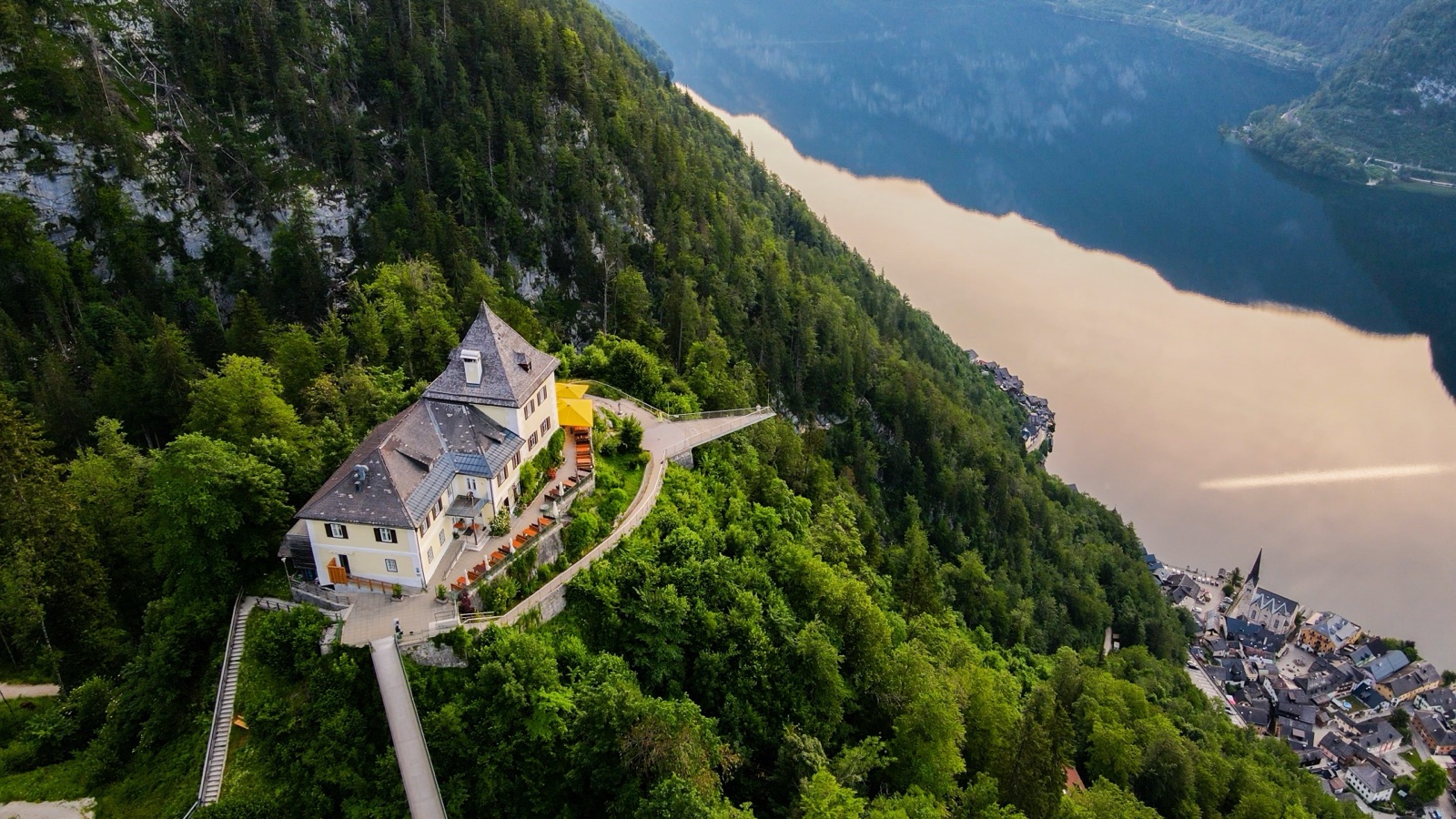
The Skywalk, also called the World Heritage view or Welterbeblick, is the other iconic Hallstatt picture. The tourist board says it hovers 350 metres above the roofs of Hallstatt. It is a 12-metre-long platform below the Rudolfsturm, the old defence tower built between 1282 and 1284 by Duke Albert I of Austria to guard the salt mines. It looks straight down on the village and along the lake to the mountains.
Getting there. The Skywalk is reached from the panoramic lift at the top of the funicular, which reopened on 29 August 2026. The funicular up and down on its own costs €29 for adults and €14 for children aged 4 to 15. Children under 4 can ride the funicular and visit the Skywalk. The zigzag footpath up from the village is closed for construction until spring 2027. The tourist board’s walking alternative goes via the Echern valley and takes between 90 minutes and 2 hours.
Hours. From 29 August to 1 November 2026 the funicular ran from 9.00 a.m., with the last ride down at 6.00 p.m. From 2 November 2026 to 6 January 2027 it runs from 9.00 a.m. to 4.30 p.m., last ride down. The platform can only be reached while the funicular runs, so plan evening light around the last ride down.
Light and weather. The Rudolfsturm is the only place in the high valley that gets sun at the winter solstice. On some days, Salzwelten says, the Skywalk looks out over a sea of clouds and mountain peaks. That is worth knowing on a grey day in the valley, when the platform may be above it. The Rudolfsturm restaurant, a 2-minute walk from the top station, has a large terrace over the southern part of the lake. See our salt mine and Skywalk guide for the full ticket list.
The panorama trail: the free view from above
If you do not want to pay for the funicular, the panorama trail gives a view over the rooftops for nothing. The tourist board calls it a tip for day visitors, a 60-minute walk. It begins behind the cemetery at the Catholic church and climbs a few steps onto a forest road. From there you see the tower of the Protestant church, the ferry dock in the Markt district and the mountains of the World Heritage area.
Follow the forest road gently uphill to the bridge over the Mühlbach waterfall, where it changes from gravel to asphalt. About 200 metres after the bridge, past a viewing hut, the Müllerstiege staircase drops back into the village past houses built onto the rock. That is a second set of photographs of its own. Our hiking guide has the route in full.
The view from the lake
The tourist board says that only from the lake do you get this view of the village with the mountains around it. The cheapest way to get it is the ferry Stefanie. It runs every day of the year between Hallstatt Markt and the railway station across the lake, for €4 one way and €8 return. The crossing takes about 15 minutes, which is plenty of time to photograph the village growing ahead of you. Arriving by train and crossing by boat is the classic first view of Hallstatt.
For more time on the water, the southern round trip via Lahn and Obertraun takes about 50 minutes and runs from May to September. It costs €18 for adults and €12 for children aged 4 to 13. The northern round trip to Untersee and Steeg runs only in high summer, from 18 July to 16 August, and costs €25 for adults. You can also hire a boat and choose your own angle: in fine weather the boat hire opens daily from 10:00 to 17:00, from April to mid-October 2026. Our Lake Hallstatt article has the timetables.
The Hirschaualm: the southern lake
The walk to the Hirschaualm, between Hallstatt and Obertraun, is the tourist board’s family pick for a view down the southern part of the lake. It takes about an hour and a half. It is a good choice in the afternoon, when the village viewpoints are at their busiest.
The Echern valley and the Waldbachstrub
Not every good Hallstatt photograph has the village in it. The tourist board calls the Echern valley a break from the crowds and a good place for landscape photos. The Waldbachstrub waterfall at its head plunges over the edge of a 90 m gorge in three levels, where three streams meet. The family-friendly hike there is about 2.5 hours. The Glacier Garden on the way, a relic of the last Ice Age, can be visited in all weathers.
5fingers and the Welterbespirale
For the whole lake from above, go to the Dachstein above Obertraun. Section 2 of the cable car, from the Schönbergalm to the Krippenstein, serves 5fingers and the viewing platforms.
- 5fingers. The platform projects like a hand over a drop of more than 400 metres. Its five walkways each measure four metres by one. One is made entirely of glass, and on another a large Baroque picture frame frames Hallstatt far below. A photo-point camera takes souvenir pictures, which you collect at a terminal at the Krippenstein top station. From the top station the walk takes about 35 to 40 minutes.
- The Welterbespirale. A viewing platform on the 2,100-metre summit of the Krippenstein with a 360-degree view of the Dachstein and the Salzkammergut. It is about 15 minutes’ easy walk from the top station. From there you can walk on to 5fingers in about 10 to 15 minutes.
5fingers is open in summer 2026 from 1 May to 1 November. The Dachstein Panorama-Ticket, which includes the ride up and down on sections 1, 2 and 3, costs €46.70 for adults. Our Dachstein guide covers the cable car and the ice caves.
Lake Gosau and the Zwieselalm
The Dachstein glacier rising behind Lake Gosau is, in the tourist board’s words, what makes Gosau one of the region’s top destinations. Humboldt called the lake the Eye of God. The reflection is best on a still morning, from the inn’s end of the lake. For the view from above, the Gosaukamm cable car lifts you to the Zwieselalm. There the Zwieselalmhöhe gives a 360-degree view of the Dachstein, the Gosaukamm and the Salzburger Land. See our Lake Gosau guide for buses, parking and prices.
Summit views: the Plassen and the Hoher Sarstein
For photographers who hike, two summits frame the lake.
- The Plassen, behind the salt mine. From the summit cross you see the Gosaukamm and, on a clear day, the Schafberg above Lake Wolfgang and the Bavarian mountains.
- The Hoher Sarstein, 1,975 m, on the east side of the lake. It is known for its view of the north side of the Dachstein and the Hallstatt glacier. The climb takes nearly three to four hours.
Both are full mountain days. Read the safety notes in our hiking guide before you go.
Sunrise and early light
The best time to photograph Hallstatt is early, before the day visitors arrive, when the lake is often at its calmest. For dedicated sunrise trips the tourist board’s own recommendations are in the mountains. It recommends the sunrise at the Simony Hut below the Dachstein glacier, best combined with a night at the hut. Above Gosau, the Löckermoos moor lake is known for its sunrise. Both mean an overnight stay or a very early start, and the usual mountain rules apply: check the hut is open, and note the last cable cars.
Viewpoints through the year
- Summer. Long days and the lake boats are all running. The village viewpoints are at their busiest, so go early or late.
- Autumn. Clear days and autumn colour, and fewer visitors. The tourist board rates autumn as the best season for the Gosau lakes.
- Winter. The funicular runs shorter hours, and the round-trip boats stop. Snow on the roofs can make the photo point at its most magical. The ferry still runs every day.
- Spring. Fresh green and snow still on the peaks. The high trails may still be closed by snow.
Our weather article explains the low cloud and fog. Our winter guide covers what is open in the cold months.
Practical tips for better pictures
- Bring a wide lens or use your phone’s wide setting for the Skywalk and 5fingers, where the view drops away below your feet.
- Keep the phone strap on on the platforms and the ferry. A dropped phone over a drop of more than 400 metres is gone.
- Look for reflections on still mornings at the photo point and at Lake Gosau, and shoot low over the water.
- Turn round. From the photo point and the panorama trail, the mountains behind you are often as good as the village in front.
- Respect the people in your frame. Residents live in the houses you are photographing.
Putting a photography day together
- Early morning. The classic photo point before the coaches arrive, then the Müllerstiege and the market square.
- Late morning. Funicular up to the Skywalk, lunch at the Rudolfsturm.
- Afternoon. The Echern valley or the Hirschaualm, away from the crowds.
- Evening. Back at the photo point or on the lakeside path as the village empties.
If you are coming from Salzburg, a private tour handles the logistics. The private salt mine and Skywalk tour includes the funicular, and the private 5 Fingers and Gosausee tour adds the Dachstein platform and Lake Gosau. Both are on our tours page.
Frequently asked questions
Where is the famous Hallstatt photo taken from? From the classic photo point, a short walk from the market square. The tourist board’s walking tour, which starts at the Hallstatt Nord bus stop, reaches it after a short walk.
Is the Hallstatt Skywalk worth it? For the view from above, yes. It hovers 350 metres above the roofs, and the funicular up and down costs €29 for adults. The walking path up is closed until spring 2027.
Can I fly a drone in Hallstatt? The village asks visitors not to. Drones are not welcome because they invade the residents’ privacy, and it suggests the Skywalk for aerial-style photos.
Is there a free viewpoint above the village? Yes. The panorama trail behind the Catholic church, about a 60-minute walk, looks over the rooftops to the Protestant church and the Markt ferry dock.
When is the best time to photograph Hallstatt? Early morning and evening, when the lake is calm and the day visitors have not yet arrived or have left.